Every school morning in Greater Houston, thousands of yellow buses leave their depots before sunrise to beat traffic on I-10, the Beltway and 290. For transportation directors in Houston ISD and the districts around it, the hard part is no longer the buses. It is the drivers, the routes and the budget. This guide shows how school bus routing software built on AI helps Houston-area ISDs cover every student with the drivers they actually have.
The Houston school bus driver shortage, district by district
In October 2025, ABC13 asked the largest districts in the Houston region how many bus drivers they had against how many they needed. The answers show how uneven the picture is.
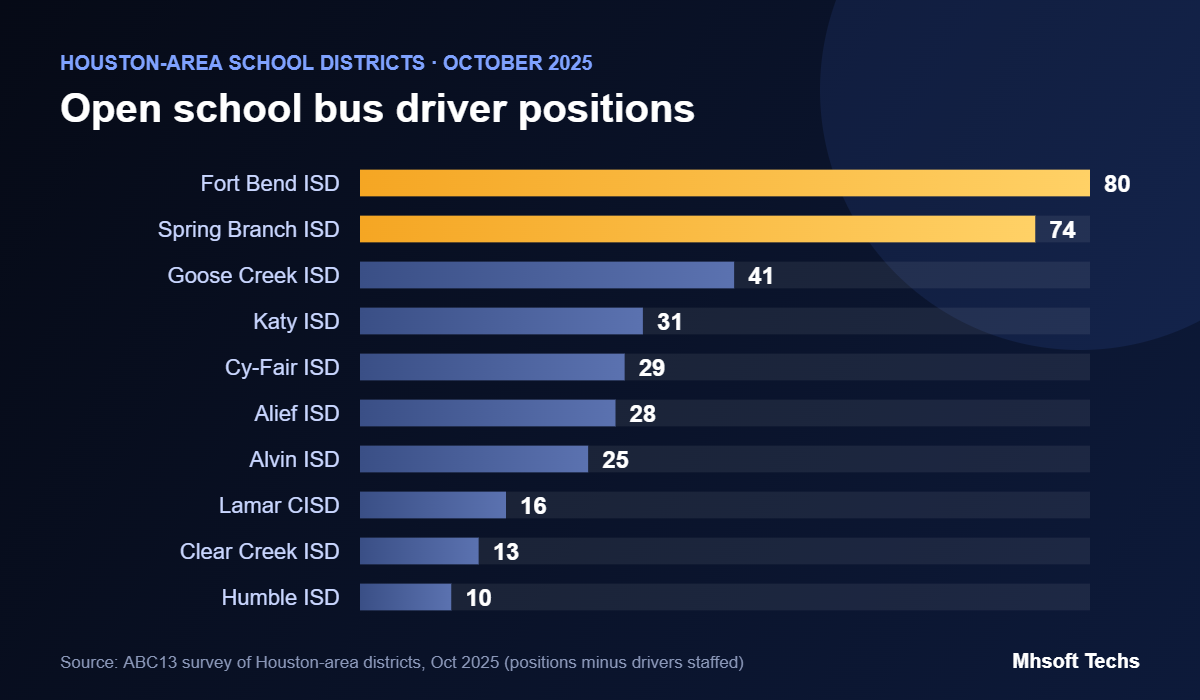
- Fort Bend ISD had 216 drivers for 296 positions, about 73% staffed. The district has started recent school years with 30 to 40 routes without a permanent driver and approved a $31.65 million contract with an outside transportation company in 2025.
- Spring Branch ISD had 115 drivers for 189 positions, the second-largest gap in the survey.
- Katy ISD was 31 drivers short and Cy-Fair ISD 29 short. Cy-Fair raised its starting driver pay from $19.19 to $23 an hour and restored full bus service for 2025-26.
- Houston ISD, the largest district in Texas, and Klein ISD both reported being fully staffed. Klein moves about 22,000 students a day and keeps a waiting list of trained drivers.
- Crosby ISD pushed back school start times in November 2025, citing a growing student body and a bus driver shortage.
The takeaway for Houston ISD and its neighbors: even a fully staffed district is one flu season away from combined routes and late buses. The route plan decides how much slack you have.
Why Houston routes are harder to plan than most
- Traffic that changes by the hour. A route that works at 6:30 a.m. can run 20 minutes late at 7:15 on the same freeway.
- Huge, spread-out districts. Fort Bend, Katy and Cy-Fair cover large suburban areas where new subdivisions open every year.
- Weather. Heavy rain and street flooding can close roads with little notice, so districts need to re-route quickly.
- Funding that doesn’t cover the real cost. Texas pays a flat $1.00 per eligible regular route mile, while one Texas district reported a real cost of about $3.18 per mile in 2023-24. Every extra mile comes out of the local budget.
How AI school bus routing software helps Houston ISDs
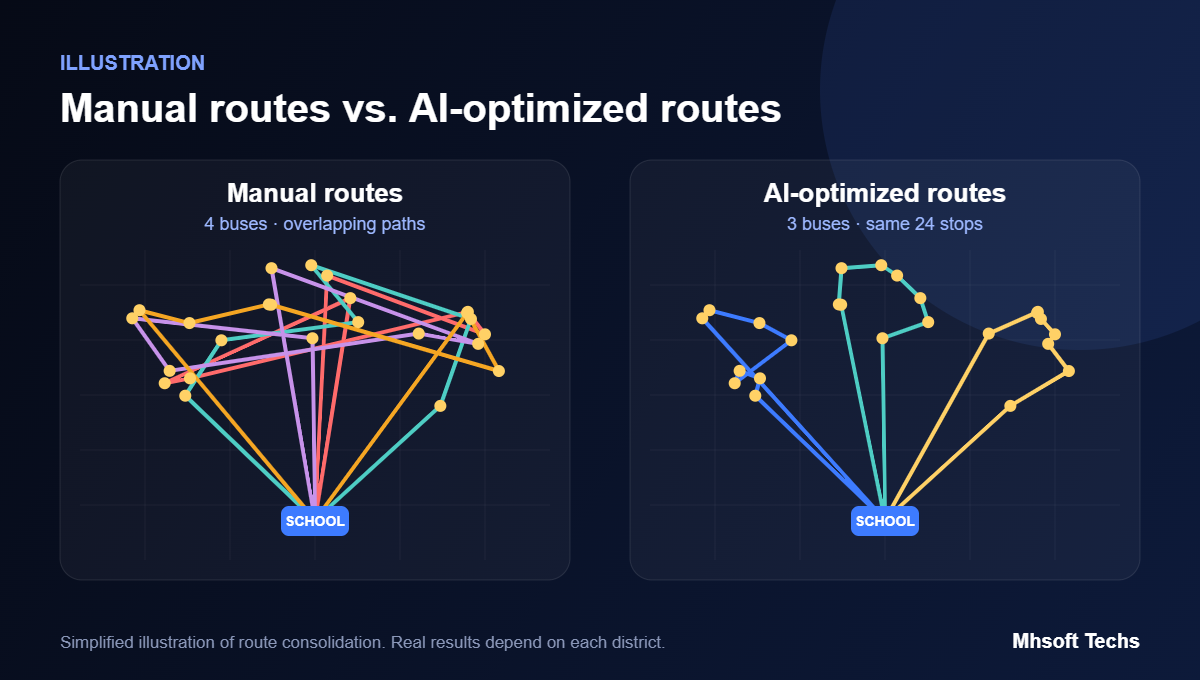
AI routing software takes your student addresses, stops, bell times, bus capacity and ride-time rules, then builds route plans that serve every eligible student with fewer, fuller routes. Your transportation team reviews the options and picks the best one.
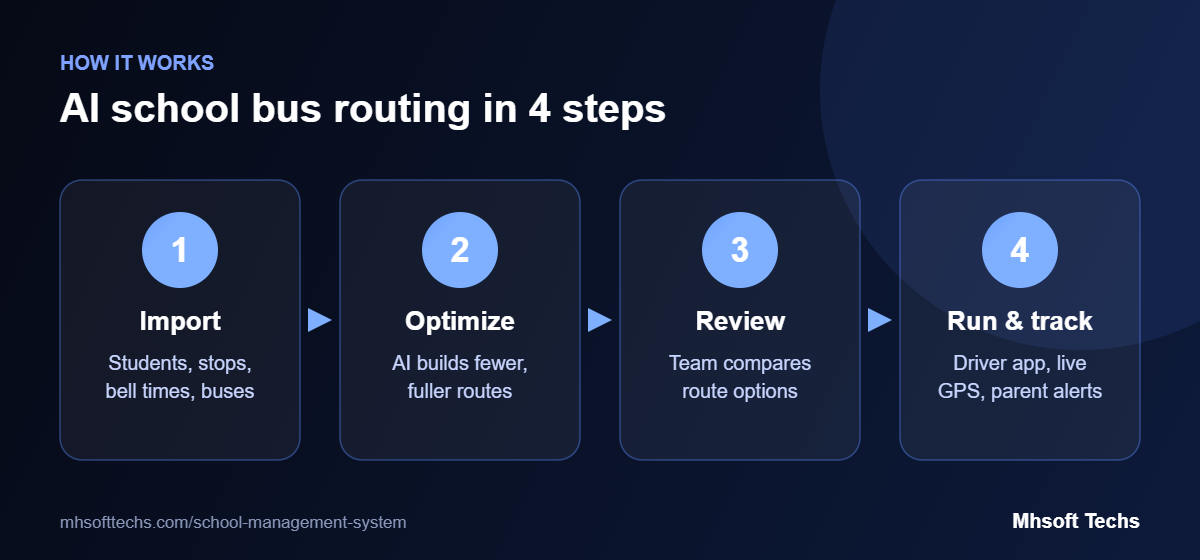
- Cover vacancies without combining routes at the last minute. Fewer, better-planned routes mean the drivers you have can cover every student.
- Bell-time scenarios. Test how staggering start times by 15 to 30 minutes lets one driver run two routes, before the board votes.
- Fast re-routing for new subdivisions. Add new neighborhoods in Katy, Fulshear or Cypress in minutes, not weeks.
- Storm-day re-routing. Close a flooded street and let the software suggest a detour for every affected route.
- Live GPS tracking and parent alerts. Parents see when the bus is close and when their child was picked up, which cuts calls to the transportation office.
- Cleaner mileage data. Accurate route miles make TEA transportation reporting easier.
Quick checklist for Houston-area transportation directors
- Can the software import students and stops from our student information system or spreadsheets?
- Can we set Texas rules like the two-mile eligibility zone and hazardous route exceptions?
- Does it handle special education routes and McKinney-Vento students?
- Does it include a driver app with turn-by-turn stops and live GPS?
- Can we model bell-time changes before school board meetings?
- Can parents get pickup and drop-off notifications on their phones?
Frequently asked questions
Is AI school bus routing software only for big districts like Houston ISD?
No. Smaller districts such as Pearland, Dickinson or Deer Park ISD benefit too, because every route they save is a large share of their transportation budget.
Can routing software fix the bus driver shortage?
Not on its own. Pay, training and support still matter. Better routing lets each driver serve more students, so a shortage causes fewer cut routes and late buses.
How long does it take to set up?
It depends on your data. Most of the work is importing students, stops and bell times. Mhsoft Techs sets up and tests the routes with your team before going live.
The bottom line
Houston-area districts reported 368 open bus driver positions in October 2025, and Texas covers only $1 of every route mile. Smarter routes are the fastest way to do more with the drivers and buses you already have.
Mhsoft Techs builds AI school routing software for Houston ISD, its neighboring districts and K-12 schools across Texas, with route planning, live bus tracking, a driver app and parent alerts. Book a free demo to see your own routes optimized. You can also read how AI routing helps K-12 districts with the driver shortage.
Sources
- ABC13: Houston-area districts work to fill hundreds of bus driver vacancies (Nov 2025)
- Community Impact: Fort Bend ISD $31.65M transportation contract
- Cy-Fair ISD restores 2025-26 transportation services
- ABC13: Crosby ISD changes school start times
- Texas Education Agency: Transportation funding one-pager
- Bracket ISD: Overview of Transportation Services (2025)